 AI-generated image
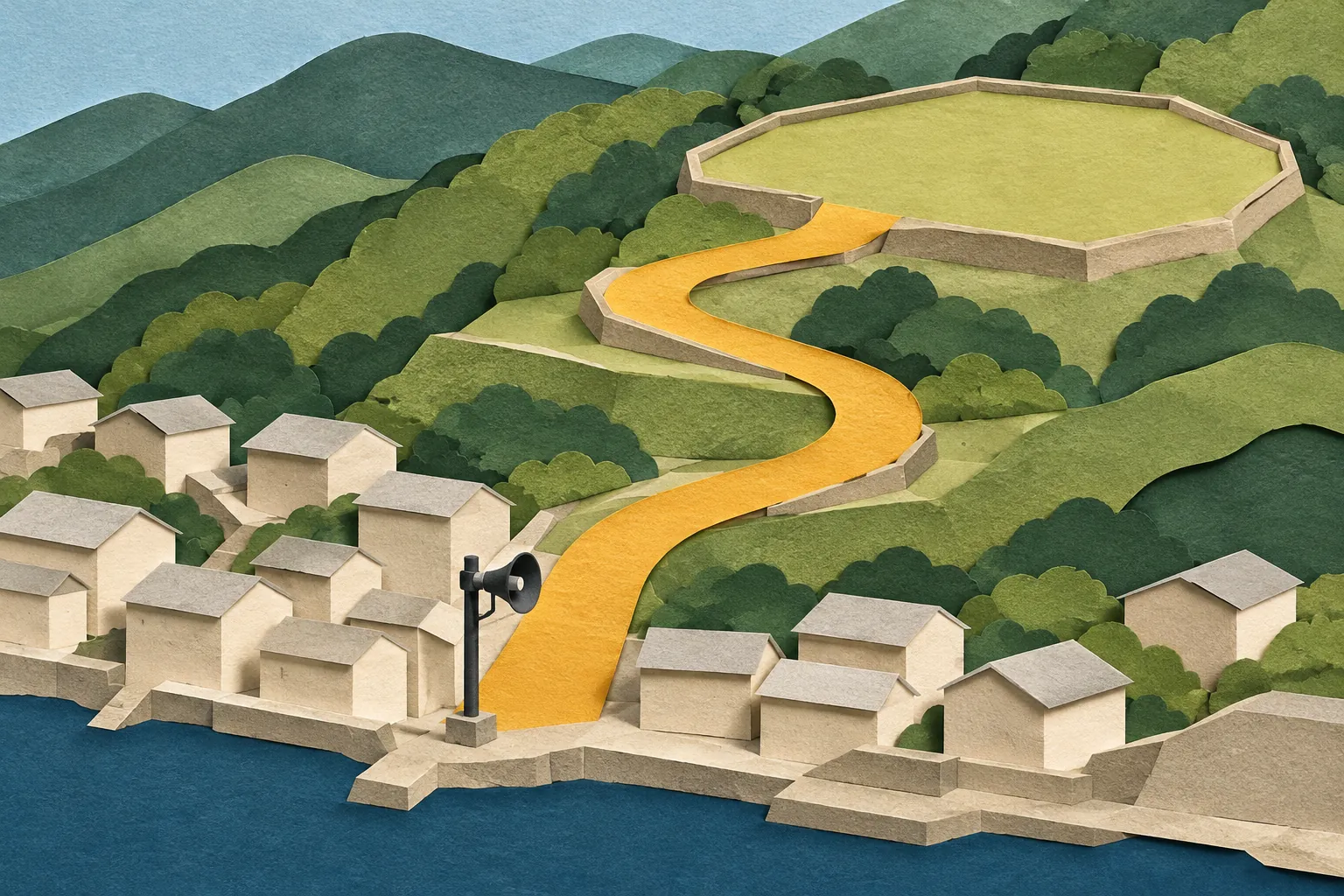
The police station grounds were on the list. So was the Ignacio Hernández school. When a tsunami alert reached the Galápagos in July 2025, Ecuador’s tourism ministry asked guides and tour operators to tell visitors where they could go. Both sites were in Puerto Baquerizo Moreno, on San Cristóbal Island. The provincial emergency committee ordered local officials to open designated safe zones and evacuate high-risk areas across the islands. Even a visitor hearing the warning for the first time had somewhere to go. Ecuador’s tourism ministry notice, Galápagos emergency committee resolution
Ecuador had been preparing for years. The 2016 earthquake off Pedernales exposed weaknesses in monitoring and response. The country expanded ocean monitoring and drew up procedures for issuing alerts. In January 2025, the Galápagos government ran a tsunami drill that moved participants to designated safe zones on four islands. UN case study, Galápagos government drill record
When an earthquake near Russia’s Kamchatka Peninsula sent a tsunami across the Pacific that July, officials had hours to monitor conditions and prepare an evacuation. They replaced a prerecorded call for immediate evacuation, designed for a nearby tsunami, with a cautionary announcement suited to the distant one. More than 2,300 people evacuated in the Galápagos, according to the case study published this November by the UN Office for Disaster Risk Reduction (UNDRR). A tsunami generated close to shore can arrive within minutes. The time available in the Galápagos that day depended on how far the waves had to travel. UN case study, NOAA on tsunami arrival times
In 2022, the UN set a goal of protecting everyone on Earth with an early warning system by the end of 2027. A report released at COP31 this month by UNDRR and the World Meteorological Organization counted 136 countries that said they had systems for several kinds of hazards as of August. The previous report counted 119. The latest report puts the 2015 figure at 56. Of the 136 countries, only 64 reported capabilities in all four areas the agencies track, from understanding local hazards to preparing to act on a warning. The goal concerns every person. Those figures describe what governments say they have in place. WMO on the 2027 goal, 2025 report, 2026 report
The Lloyd’s Register Foundation’s World Risk Poll asked people about the disaster that had affected them most in the previous five years, excluding COVID-19. Gallup conducted the survey in 2025. In UNDRR’s analysis, about four in five of those who had experienced a disaster said they received an advance warning. Of those who received one, 64 percent said it enabled them to take some action before the disaster. Per 100 respondents who experienced a disaster, about 29 said they received a warning and still could not act. The survey does not establish what would have helped those 29. World Risk Poll questionnaire, UNDRR’s survey analysis
Corazon Bajuyo Clarin, speaking in a separate UNDRR report in 2023 as the convener of a disaster risk reduction network in Cebu that works with people with disabilities, described what a warning can leave unresolved. Without preparation, she said, it could be hard for her even to reach the things she needed or to go and ask for help. If someone at the foot of a planned route needs assistance, planners have someone else’s journey to account for, too. UNDRR’s report on disability and disasters
Under the Sendai Framework, the UN already asks governments that can provide the figures to report evacuations after early warning. This year’s report calls for wider reviews of what happened once a warning went out. Take that work down to the scale of a neighborhood. Bring people who need assistance into the design of the exercise. Record how many participants got the warning in time, how many reached safety and where people ran into trouble. Publish anonymized results, fix the problems and drill again. Sendai Framework reporting methodology, 2026 report recommendations
For a participant who had to wait for help, the drill should record when the warning arrived, when help was requested and when it actually came. Those intervals tell a town where it can buy people more time before the next warning.
Sources
Links in the text lead to the original material the journalist used.
- Ecuador’s tourism ministry notice historicomintur.produccion.gob.ec
- Galápagos emergency committee resolution gobiernogalapagos.gob.ec
- UN case study preventionweb.net
- Galápagos government drill record gobiernogalapagos.gob.ec
- NOAA on tsunami arrival times noaa.gov
- WMO on the 2027 goal wmo.int
- 2025 report public.wmo.int
- 2026 report recommendations undrr.org
- World Risk Poll questionnaire lrfoundation.org.uk
- UNDRR’s survey analysis undrr.org
- UNDRR’s report on disability and disasters undrr.org
- Sendai Framework reporting methodology undrr.org
Revision history
No revisions.
Discussion
Questions, counter-arguments and sourced corrections are welcome. Comment policy
Loading comments…